Diane Haefner Katsuhiko Matsubara Shunsaku Hayashi Leaking Life
Berlin 20 Nov 2026 – 23 Jan 2027


LEAKING LIFE
Diane Haefner · Katsuhiko Matsubara · Shunsaku Hayashi
Life is not a fixed or self-contained state. It unfolds through transitions, through processes that resist stable definition and whose boundaries repeatedly become porous. Matter shifts, forms merge into one another, dissolve, and reappear elsewhere. What is perceived as a distinct entity is at the same time part of a larger web of relations in which everything affects everything else. Under the title Leaking Life, REITER brings together works by Diane Haefner, Katsuhiko Matsubara, and Shunsaku Hayashi, whose practices each approach, in different ways, the idea of a living world in continual transformation.
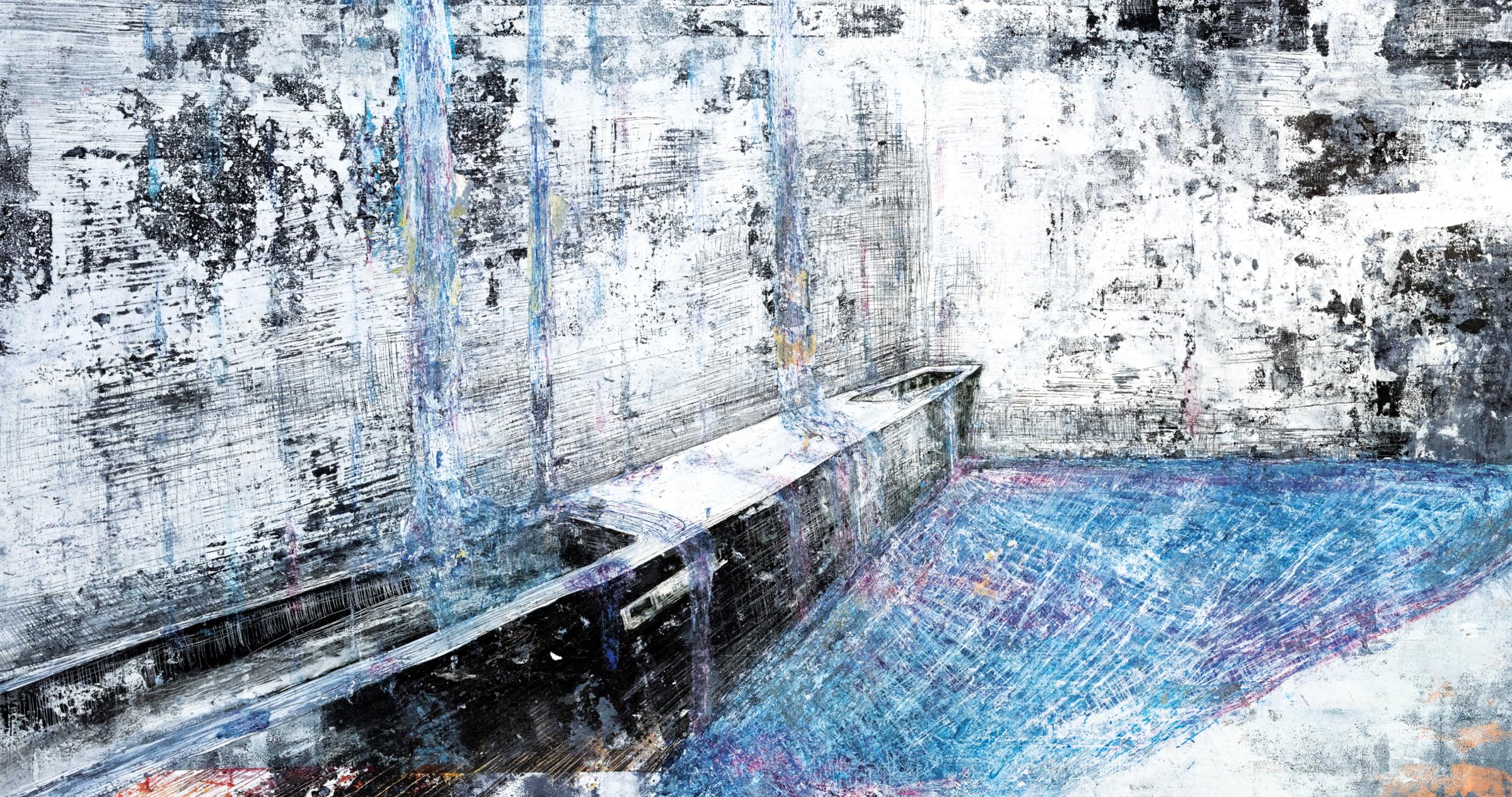
The exhibition takes its title from Shunsaku Hayashi’s 2019 animated film of the same name. It begins with an everyday observation: a tea bag dropped into a glass of water, its contours dissolving as the liquid gradually changes color. From this inconspicuous moment, Hayashi develops a visual world in which the movement of water increasingly takes on a life of its own. Waves turn into clouds, liquids spread, forms dissolve, and new structures emerge. Elsewhere, water leaks from a faulty drain into a domestic interior and continues, inexorably, through its surroundings. The film does not follow a linear narrative, but unfolds through visual association and rhythmic shifts. In the process, it creates a peculiar tension between the familiarity of its point of departure and the increasingly strange imagery that grows out of it. Water becomes a metaphor for a kind of matter that cannot be permanently contained, and whose movement continually generates new connections.
A related conception of the world underlies Katsuhiko Matsubara’s painting. Born in Tokyo and based in Berlin, the artist engages with an animistic worldview in which the separation between human and nature, spirit and matter, is not understood as self-evident. Rather, the world appears as a network of relations in which everything is interconnected and mutually permeable. Matsubara is particularly interested in traces of this way of thinking within the history of Western modernism. His engagement with Japonisme is concerned less with questions of formal influence than with the fundamental shift in perception that accompanied the encounter between Japanese art and European painting in the nineteenth century.
In his paintings, landscapes emerge only gradually from the materiality of color. Vegetation, bodies of water, and other natural forms seem to appear without ever fully resolving into a clearly legible image. The large-scale canvases are shaped by an interplay of transparent glazes and denser layers of paint that overlap and permeate one another. Light and color seem to spread across the picture plane, while the contours of motifs repeatedly blur. The result is the impression of a landscape that is less observed than entered, a space in which perception does not remain outside the event, but becomes part of it. In this sense, Matsubara does not treat the canvas as a neutral surface on which an image is fixed, but as a site where color, light, and material enter into relation. His painting evolves out of this interplay and retains a persistent sense of incompletion, as though the forms it depicts were still in the process of coming into being.
With Diane Haefner, this notion of transition becomes immediately corporeal. Her porcelain sculptures evoke human anatomies, vegetal formations, or strange organisms, yet cannot be clearly assigned to any one of these categories. Bodily fragments appear to merge with vegetal forms; familiar structures are altered and reconfigured within new contexts. The resulting formations are at once seductive and disquieting. They evoke beings whose shape has not yet fully taken form, or whose development continues in an unknown direction.
Porcelain plays a crucial role here. Its traditional associations with refinement, preciousness, and fragility stand in a striking tension with the at times grotesque or monstrous appearance of the sculptures. The glazed surfaces, subtle tonal gradations, and almost skin-like textures lend the works a pronounced sensuality. At the same time, they retain something alien that resists full deciphering. Haefner deliberately operates within this tension between beauty and uncanniness. Her sculptures do not appear as self-contained bodies, but as hybrid formations in which different conceptions of corporeality collide. In doing so, they also touch on the question of how deeply our perception of the body is shaped by cultural attribution and fixed ideas, and what happens when those assumptions begin to lose their hold.
Alongside the animated film, paintings by Shunsaku Hayashi are also on view in the exhibition. The relationship between painting and film is central to his practice. The two media remain in continuous exchange and open up different ways of engaging with movement, time, and perception.
In Leaking Life, three artistic positions come together, each approaching the mutability of living form in its own way. Matsubara approaches this idea through an animistic understanding of the world, in which nature and matter appear as interconnected forces. In Hayashi’s work, it becomes tangible in the movement of water and in the continual transformation of his cinematic images. Haefner, in turn, gives it corporeal form by dissolving familiar anatomical conceptions and allowing hybrid beings to emerge. What connects these works is an interest in moments when an existing form exceeds its own limits and opens itself to something new. The exhibition title describes this process as a crossing over, a leakage from the familiar, in which the surrounding environment is likewise transformed. Life appears here as something mobile and unfinished, a process that continues by continually altering its own form.
Diane Haefner, born in Heidelberg in 1994, studied Fine Art at the Hochschule für Gestaltung Offenbach, graduating in 2023. In her porcelain sculptures, she develops hybrid forms situated between anatomy, organic growth, and artificial materiality. Her work has been shown, among other venues, at Kunstverein Bielefeld, Lycra in Hamburg, TOR Art Space in Frankfurt, as well as in exhibitions in Berlin, Leipzig, and Offenbach. She also works at the Ceramic Art Lab at HfG Offenbach.
Katsuhiko Matsubara, born in Tokyo in 1986, lives and works in Berlin. From 2016 to 2021, he studied painting and drawing under Prof. Anselm Reyle at the Hochschule für bildende Künste Hamburg. His painting brings together Western traditions of modernism with an animistically inflected understanding of nature, matter, and perception. He was a fellow at Künstlerhaus Bethanien and has recently exhibited in Berlin, Hamburg, Augsburg, and Emsdetten, among other places.
Shunsaku Hayashi, born in Osaka in 1992, is a filmmaker and visual artist. In his practice, he combines painting, animation, and experimental film into a poetic visual language in which movement, time, and transition are central. He is currently a fellow at Künstlerhaus Bethanien, supported by the Pola Art Foundation.
Artists
- Diane Haefner
- Katsuhiko Matsubara
- Shunsaku Hayashi